

Introduction
Education has always been the cornerstone of empowerment for persons with disabilities. Yet historically, education systems across the world, including in India, have struggled to accommodate diverse learning needs. Barriers such as inaccessible learning materials, lack of trained teachers, rigid assessment systems, and societal attitudes have often prevented children with disabilities from fully participating in education.
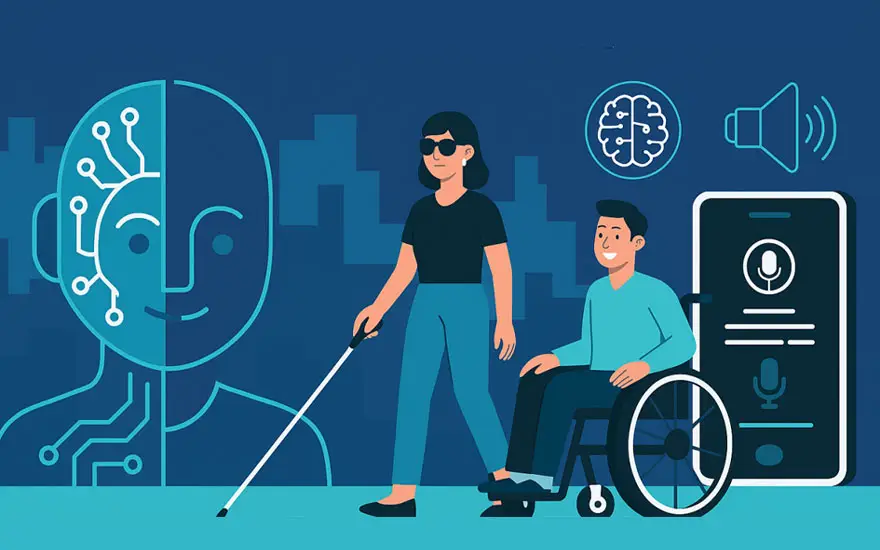
The emergence of ArtiHicial Intelligence (AI) is beginning to transform this landscape. AI-powered technologies are opening new possibilities for accessible and personalized learning, enabling students with disabilities to overcome barriers that were once considered insurmountable. From speech recognition software and intelligent tutoring systems to real-time captioning and adaptive learning platforms, AI is reshaping how education can be delivered and experienced.
However, AI is not a magic solution. Like all technologies, it is a double-edged sword. While it has the potential to democratize education, it can also reinforce inequalities if accessibility, affordability, and ethical considerations are not addressed. The challenge before educators, policymakers, and technologists is to ensure that AI becomes a tool of inclusion rather than exclusion.
As disability rights advocate Haben Girma, American advocate, who was the Hirst deaHblind graduate of Harvard Law School, has often emphasized: “Disability drives innovation.” ArtiHicial Intelligence, when developed inclusively, can become one of the most powerful innovations advancing educational equality.
Historical Barriers in Education for Persons with Disabilities
Before understanding the transformative role of AI, it is important to recognize the barriers that have traditionally limited access to education for persons with disabilities. Across many countries, including India, students with disabilities face multiple obstacles. Physical barriers remain a persistent issue. Many schools and colleges lack ramps, accessible toilets, or transportation facilities, making attendance itself a challenge. Learning barriers also exist. Students with visual impairments may not have textbooks in Braille or accessible digital formats. Deaf students may not have sign language interpreters. Students with learning disabilities may struggle with standardized teaching methods that do not match their cognitive styles.
Teacher preparedness is another challenge. Many teachers receive little or no training in inclusive pedagogy or assistive technologies. Finally, attitudinal barriers often discourage students with disabilities. Low expectations, stigma, and discrimination frequently undermine their conHidence and opportunities.
According to global education estimates, children with disabilities are two to three times more likely to be out of school than their non-disabled peers according to UNESCO 2018 report N for Nose. Even those who enter school often drop out early due to lack of support (Education and Disability: Analysis of Data from 49 Countries – Information Paper N. 49 March 2018 – UNESCO Institute for Statistics).
ArtiHicial Intelligence, when used thoughtfully, has the potential to address many of these long-standing barriers.
AI as a Tool for Accessible Learning
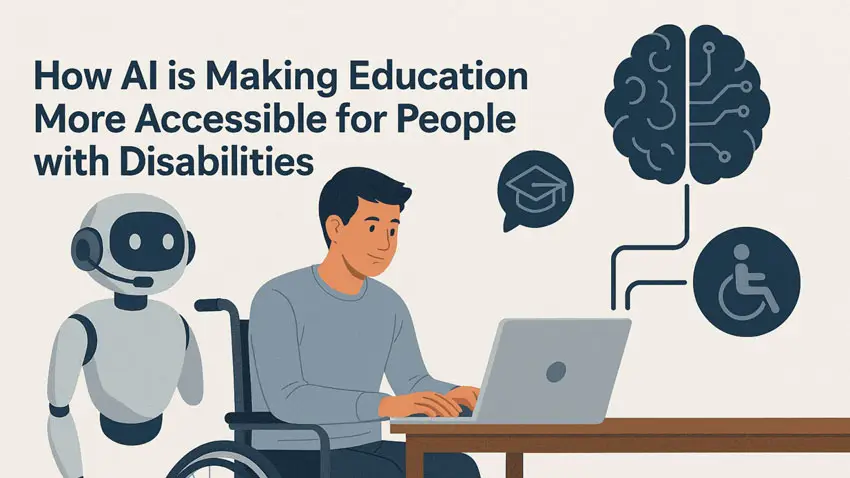
One of the most powerful contributions of AI lies in its ability to convert information into accessible formats. AI brings several advantages to the education of students with disabilities:
1. Personalized learning: AI systems adapt lessons based on the student’s needs, pace, and abilities.
2. Greater accessibility: Speech recognition, text-to-speech, and image recognition tools make educational materials accessible.
3. Increased independence: Students can complete tasks without constant assistance from teachers or peers.
4. Improved communication: AI-powered translation and captioning tools help students communicate more effectively.
These beneHits contribute to a more inclusive education system where students with disabilities have equal opportunities to succeed.
For students with visual impairments, AI-based screen readers and text-to-speech technologies allow textbooks, research articles, and digital content to be read aloud. Optical character recognition systems can scan printed materials and convert them into digital text that can be accessed through assistive software.
A widely used example is Seeing AI, developed by Microsoft. The application uses computer vision and machine learning to interpret the visual world by reading printed text, identifying objects, and describing scenes. Blind students in universities across the United Kingdom and the United States use such applications to scan textbooks and classroom handouts. Instead of waiting weeks for books to be converted into accessible formats, they can access information instantly.
For deaf and hard-of-hearing students, AI-driven speech recognition tools can generate real-time captions during lectures or video content. Applications such as Live Transcribe, developed by Google, convert spoken words into written text almost instantly, allowing students to follow lectures in real time.
Students with mobility impairments beneHit from voice-controlled systems that allow them to operate computers, write assignments, or browse educational content without relying on physical keyboards.
For students with dyslexia or other learning disabilities, AI-powered reading tools can simplify complex text, highlight key ideas, and adjust reading speeds according to individual preferences. One signiHicant real-life example of AI supporting students with disabilities comes from the University of Cambridge, where researchers developed an AI-powered reading tool to assist students with dyslexia. The system analyzes how a student reads and identiHies patterns of difHiculty. It then adjusts the presentation of text
by modifying spacing, font size, and color contrast. The AI can also highlight problematic words and provide pronunciation support.
Students who used the tool reported improved reading speed and comprehension. This example shows how AI can adapt educational materials to meet individual learning needs.
These technologies not only provide accessibility but also enhance independence and conHidence, enabling students with disabilities to engage in education on more equal terms.
Personalized Learning Through AI
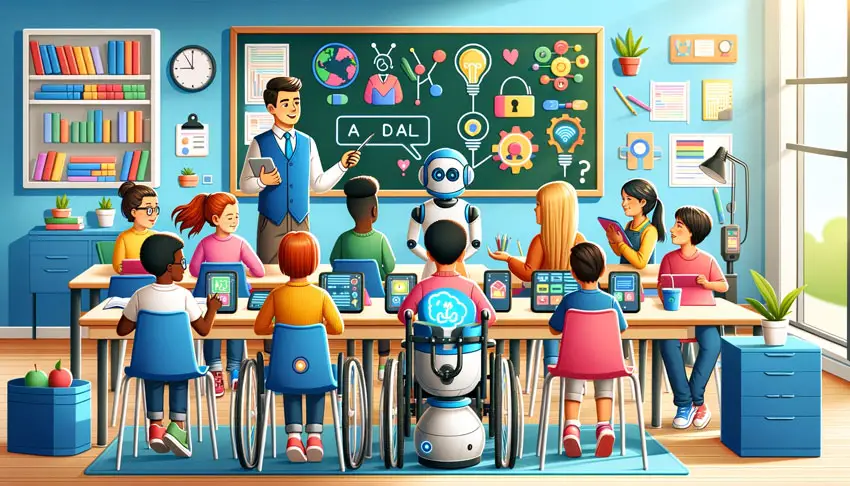
Traditional education systems often assume that all students learn in the same way and at the same pace. This assumption disadvantages students with diverse learning needs. AI makes it possible to create personalized learning environments. Adaptive learning platforms analyze how a student interacts with educational content and adjust lessons accordingly. If a student struggles with a concept, the system can provide additional explanations, exercises, or alternative teaching approaches. An example is the adaptive mathematics platform developed by DreamBox Learning, which uses AI to tailor instruction to each student’s learning patterns. For students with disabilities, such personalization can be transformative. A student with autism, for instance, may prefer structured and predictable learning environments. AI-based platforms can provide consistent routines and visual supports.
Students with attention deficit disorders may benefit from shorter, interactive learning modules that maintain engagement. Similarly, students with cognitive disabilities can progress at their own pace without the pressure of keeping up with an entire classroom. By tailoring education to individual needs, AI has the potential to make learning more inclusive and effective.
AI-Powered Assistive Technologies
Assistive technologies have long played an important role in disability inclusion. Artificial Intelligence is now enhancing these tools in remarkable ways. AI-powered visual recognition systems can describe objects, people, and environments for blind or low-vision students. A student can point a smartphone camera at a diagram or classroom board and receive an audio description. Speech-to-text applications allow students with physical disabilities or dysgraphia to dictate essays and assignments rather than writing them manually.
Students with spinal cord injuries or muscular dystrophy widely use voice typing systems integrated into platforms from Google and Microsoft to complete assignments independently. The late physicist Stephen Hawking once highlighted the importance of assistive technology in empowering people with disabilities: “Technology can enable people with disabilities to live more independent and productive lives.”
Similarly, AI-based sign-language recognition systems are being developed to translate sign language into spoken or written text, potentially improving communication between deaf students and teachers who do not know sign language.
AI and Autism Education
Students on the autism spectrum often experience challenges in social communication and emotional recognition. Researchers have developed AI-based educational tools that help children learn to interpret facial expressions and emotions through interactive learning. At Carnegie Mellon University, researchers created a system called FaceSay that teaches autistic children to recognize emotional cues through computer-based games.
In Japan, schools have experimented with humanoid robots developed by SoftBank Robotics. These robots guide children through structured activities and help them practice communication skills. Teachers have observed that some children who are hesitant to interact with people initially feel more comfortable interacting with robots, gradually building confidence before engaging with classmates.
Innovation and AI in the Indian Context
India is increasingly emerging as a hub for AI-based assistive technologies. Researchers at Indian Institute of Technology Kanpur have developed an assistive application designed to support children with dyslexia and dysgraphia. The system uses interactive exercises, auditory feedback, and touch-based learning to improve reading and writing skills.
Similarly, researchers at Amrita Vishwa Vidyapeetham are developing AI tools capable of recognizing Indian Sign Language and translating speech into sign-language avatars. Another initiative is the AI-powered learning platform SATHEE, developed by Indian Institute of Technology Kanpur with support from India’s Ministry of Education. The platform provides personalized learning paths, AI-based tutoring, and interactive learning resources.
However, large-scale impact will depend on making these technologies affordable and accessible to students across rural and urban areas.
Inclusive Assessment and Evaluation
Assessment is often one of the most difficult aspects of education for students with disabilities. Traditional examination systems typically rely on written tests conducted under strict time limits. Such formats can disadvantage students with visual impairments, learning disabilities, or mobility challenges.
AI-based assessment systems offer more flexible evaluation methods. Students can respond through voice recordings, digital presentations, or interactive problem-solving tasks. Automated feedback systems help teachers monitor student progress and identify areas where additional support may be required. Such approaches shift the focus from rigid examination formats toward evaluating genuine learning and understanding.
Teacher Support and Capacity Building
Teachers remain central to inclusive education. Yet many educators feel unprepared to support students with disabilities. AI can assist teachers by analyzing learning patterns and identifying individual student needs. AI-based educational analytics can help teachers understand which concepts students Hind difficult and design targeted interventions. Automated lesson-planning tools can suggest accessible teaching materials, inclusive instructional strategies, and differentiated learning activities.
At the same time, technology cannot replace the empathy, understanding, and creativity of human educators. AI should be seen as a tool that strengthens teachers rather than replacing them.
Challenges and Ethical Concerns
Despite its enormous potential, the integration of AI into education raises important concerns. The digital divide remains a major issue. Many students with disabilities, particularly in rural or low-income communities, lack access to devices, reliable internet connectivity, or assistive technologies. Cost barriers also persist. Advanced AI tools may remain inaccessible to schools with limited resources.
Another concern is algorithmic bias. If AI systems are trained on datasets that do not adequately represent persons with disabilities, they may fail to recognize or accommodate diverse needs. Privacy and data protection are equally important. AI systems collect large amounts of data about students’ learning patterns, and this information must be safeguarded carefully.
Finally, there is a risk that over-reliance on technology could weaken the human relationships that are essential for meaningful education.
The Way Forward
For AI to truly transform education for persons with disabilities, several steps are necessary. First, inclusive design must become a priority. Persons with disabilities must be involved in designing and testing AI-based technologies. Second, governments must invest in accessible digital infrastructure and affordable assistive technologies. Third, teacher training programs should incorporate digital accessibility and AI-based educational tools. Fourth, policy frameworks must ensure that AI technologies remain inclusive, ethical, and transparent. Finally, collaboration between governments, universities, technology companies, and disability organizations will be essential.
Conclusion
ArtiHicial Intelligence has the potential to revolutionize education for persons with disabilities. By making learning materials accessible, personalizing instruction, enhancing assistive technologies, and supporting teachers, AI can help create more inclusive educational environments. Across the world, AI is already enabling blind students to read textbooks, helping deaf students follow lectures, supporting children with dyslexia in writing assignments, and empowering students with physical disabilities to participate independently in academic life. Yet technology alone cannot guarantee inclusion. Without careful planning, ethical safeguards, and equitable access, AI could reinforce existing inequalities. The true promise of AI lies not merely in technological innovation but in its ability to expand human potential and dignity.
When guided by the principles of accessibility, inclusion, and respect for diversity, ArtiHicial Intelligence can help ensure that every learner, regardless of ability, has the opportunity to learn, grow, and contribute to society.
In this sense, the integration of AI into education is not just about technology, it is about reimagining education itself as a space where difference is valued and every mind is given the chance to flourish.
Dr. Sruti Mohapatra
CEO Swabhiman
Inclusive Education Expert sruti@swabhiman.org sruti_m@hotmail.com