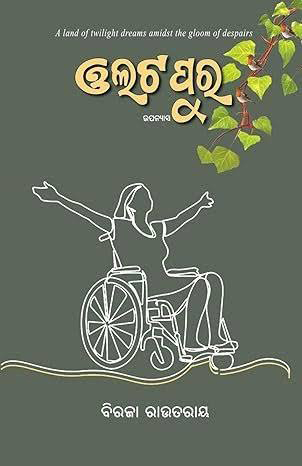
Biraja Routray, celebrated for his profound focus on marginalized lives and human resilience, delivers a masterpiece of contemporary Odia literature with Olatpur. Rather than a mere chronicle of physical impairment, the novel stands as a transformative narrative on reconstructing the self-amidst life’s greatest ruptures. Frame-by-frame, it meticulously maps the journey from devastation to empowerment, leading me to study it from my perspective: “Reconstructing the Self: Disability, Identity and Social Reintegration in Olatpur”.
Olatpur delivers a visceral, lived account of disability, tracing the painstaking reconstruction of identity in its protagonist, Simadri. Transferred to the NIRTAR rehabilitation center in Olatpur after barely surviving a catastrophic car accident at Apollo Hospital, she confronts the brutal reality of quadriplegia. This devastating revelation instantly crushes her body and spirit, plunging her into a severe crisis of physical immobility and psychological trauma.
Through a poignant flashback, the novel introduces Simadri as a high-achieving professional with an MBA from XIMB, working as a Senior Manager at NALCO, Angul. Deeply attached to her family and committed to her work, she regularly travels to Bhubaneswar on weekends to visit her parents in a new car gifted by her father, driven by their loyal driver, Sudhir. The novel, further unveils Simadri’s long-distance relationship with Rohit, a Gurgaon-based corporate executive, which dates back to their management studies. While career opportunities draw Rohit to Gurgaon, Simadri chooses NALCO to stay close to her birthplace and parents. Despite geographical distance and her parents’ mild disapproval, their emotional bond remains strong through shared life plans and mutual agreement—making this carefully built stability crucial to understanding the scale of the upcoming tragedy.
Simadri’s perfect picture of life gets shattered by this accident, killing her driver and weekend companion, Sudhir. She wakes up in the ICU only to face this tragic news and a deformed body, with the full extent of her broken world unfolding as she moves to NIRTAR, a rehabilitation center. Left with deep wounds and cuts, Simadri desperately hopes it is a bad dream, but her life has truly turned into a nightmare. Unable to accept her new self, Simadri fears being ridiculed by society and shrinks away from the world. She isolates herself entirely, permitting only her mother and a close uncle to see her. This extreme withdrawal leaves her emotionally and psychologically stranded, grieving the sudden loss of her past physical perfection and former identity.
Terrified of receiving pity, Simadri keeps to herself and strictly sticks to necessary daily chores at the rehabilitation center. However, seeing other disabled fighters helps anchor her during this painful struggle to accept her new reality. Her sole source of solace, comfort, and care during these dark early days is her caretaker, Bidulata. She firmly believes every dark night brings a new dawn, countering Simadri’s despair with steady hope. Caring for her like a sister, she creates a safe space that nurtures emotional healing. Her affectionate care goes beyond pity, easing Simadri’s grief and quietly sparking her journey to rebuild her identity.
Unlike a clinical hospital, the rehabilitation center offers an engaging environment where therapist, caregiver, and patient interactions pull Simadri out of isolation. Seeing fellow patients endure similar struggles reassures her that her pain is not unique. Their journeys comfort her, guiding her toward self-acceptance and teaching her that true deformity is more psychological than physical.
The novel precisely tracks Simadri’s subtle yet striking evolution from initial reluctance to active participation. Believing in her own healing, her newfound positivity leads her to embrace daily chores, therapy sessions, various activities, and outings with fellow inmates. This steady progress highlights the rehabilitation center as a powerful sanctuary, patiently breathing life and hope back into shattered souls.
Biraja Routray’s delicate storytelling reveals that genuine love stands firm through any trial, exposing the superficiality of Rohit’s bond with Simadri. Although their pre-accident relationship revolves around deep intimacy and future plans, Rohit’s swift withdrawal exposes his attachment as purely physical. He visits her only briefly at the hospital, abandoning her in her darkest hours. Just as Simadri prepares to let him go, Rohit’s harsh rejection strikes first— landing a soul-crushing second blow right beside her physical trauma. Rohit embodies an insensitive society that views disability as a stigma—a theme the author addresses with graceful restraint. Rather than breaking Simadri, his abandonment sharpens her self-reliance, releasing her from relying on external validation. Where romantic relation betrays her, professional solidarity restores her: her NALCO colleagues visit and invite her back to work, proving that genuine workplace support can far outweigh selfish personal relationships.
The novel reaches its climax in a high-stakes wheelchair basketball game between the center’s inmates and an outside team. Initially a hesitant participant, Simadri breaks past her physical and mental constraints, finding renewed power as the game intensifies. Here, the wheelchair shifts from a symbol of limitation to an instrument of freedom and confidence. In the final moments, with victory on the line, the coach and crowd look to Simadri as their last hope—and she delivers a triumphant win that crowns her transformation.
Before her accident, Simadri establishes her credibility as a successful professional at NALCO in just one year; now, her standout sports performance commands the public’s admiration once again. Her triumph is far more than a game—it is the victory of ability over impairment, acceptance over avoidance, inclusion over reluctance, and faith over fear. She proves that disability is not a stigma, but merely the absence of certain abilities. Rejecting a traditional closure, the novel leaves readers inspired with enduring hope to face life’s ultimate challenges.
In conclusion, Olatpur stands as a monumental triumph of disability literature—a testament to resilience, hope, and the reclamation of self through unwavering perseverance. Biraja Routray’s delicate narration captures the devastating rupture of a sudden physical disability, laying bare the psychological scars and societal prejudice that follow. Yet, against this darkness, the novel illuminates the sacred role of the rehabilitation center, proving that while cold rejection shatters the human spirit, genuine care and solidarity rebuild it. Ultimately, Olatpur leaves an indelible mark: a person is never defeated as long as they hold onto inner strength, community support, and the courage to forge a new identity from the ashes.

Dr Pravamayee Samantaray
is an Assistant Professor of English; a poet, painter, translator, literary critic, and socio-cultural activist. She also serves as the Secretary General of the Indo-Vietnam Solidarity Committee.