After some of America’s top AI executives have called for a slowdown in AI development, citing, among many things, the AI-divided world and the fear and threat of devastating cyberattacks by out-of-control agents, many tech giants, including Microsoft’s CEO Satya Nadella, suggest that AI should remain under human control. Similarly, Sam Altman, the CEO of OpenAI, advises that we have to pace the rate of AI development. Even former Anthropic researcher Jacob Coxon sounds the alarm with his prediction that “soon, superhuman systems will be able to hack anything.” For AI leaders, including Anthropic CEO Dario Amodei, there is a suggestion to slow the rate of advancement and create more time to manage its risks, an approach that has also been echoed by Elon Musk, CEO of SpaceX. In an exclusive interview with NDTV, Microsoft co-founder Bill Gates also apprehends a future with a dividing line between the AI-rich and AI-poor. Similarly, one of the most popular AI gurus and the global godfather of AI, Stuart Russell, also sounds the alarm and argues for stronger safeguards. He also predicts that superintelligence is far beyond humans.
In the above context, as the revolution of AI is soon going to shape the future course of therapeutic interventions from different perspectives, many aspects will remain challenging in this field. This is especially relevant to rehabilitation, physiotherapy, occupational therapy, speech and language therapy, special education, etc. The appealing question is how AI can transform therapy while keeping all aspects of human intervention intact. It is beyond doubt that the therapy sector will also be significantly impacted, like education, healthcare, communication, research, industry, and everyday life.
It is true that therapy has traditionally been deeply human. The role of a physiotherapist is to enhance mobility; an occupational therapist removes functional difficulties; a speech therapist develops expression; and, likewise, a special educator devises an individual learning pattern for a child. All these interventions involve clinical knowledge, observation, experience, communication, and, most importantly, human connection.
While analysing the possible impact of AI on different therapeutic applications, it will certainly give a new dimension to all these fields. Starting from analysing enormous amounts of information, identifying patterns, personalising exercises, monitoring progress, providing immediate feedback, and supporting therapists in making informed decisions, AI has the potential to transform therapeutic practice.
AI can potentially assist with assessment and screening, movement and posture analysis, speech and language assessment, personalised exercise programmes, progress monitoring, cognitive and behavioural exercises, assistive mobility and communication, documentation, clinical decision support, remote and home-based rehabilitation, predictive analytics, skilling, and the education of therapists.
Therefore, AI can function as a supporting intelligence alongside therapists.
But under the present apprehensions of the world’s top AI CEOs, the value of human intervention in future therapy is also under clouds.
The present rehabilitation professional scenario in India is almost entirely human-centric. Here, the potential question is, will AI replace a therapist to a measurable extent? As most practising therapists still rely fully on manual-based interventions supported with electrotherapy, they have not grown up in a clinical environment that understands technology critically.
The reality is that the mushrooming of institutions run by private-level players, which are producing future therapists in our country, are not equipped with this inevitable technology of the future, let alone having the availability of skilled trainers.
This does not imply that all present or future therapists need to become either programmers or machine operators. To enhance their knowledge and clinical competence, they must have AI literacy. They must have knowledge of data interpretation and awareness of digital ethics. They must be skilled in technology-assisted assessment, privacy and cybersecurity awareness, and understanding the limitations of algorithms.
Future therapists, therefore, need to acquire all this AI-enabled knowledge.
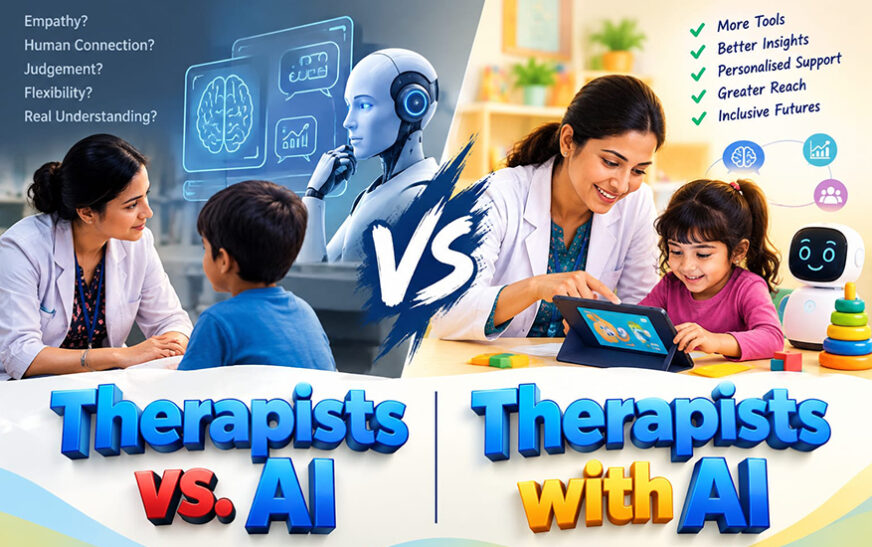
After that, it can be well defined as “Therapists with AI” instead of “Therapists vs. AI.”