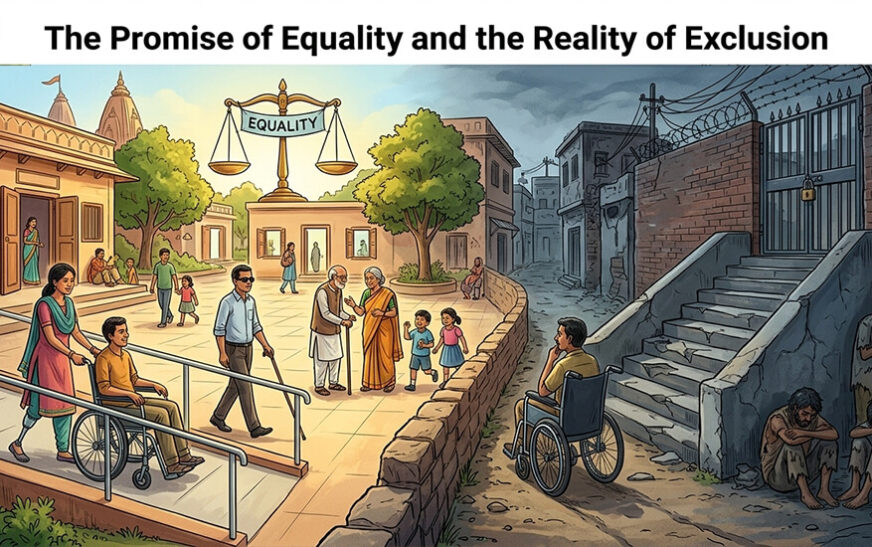
Disability is not merely an individual impairment; it is also the consequence of social, institutional and environmental barriers that prevent individuals from participating equally in society. The central question of disability jurisprudence should therefore not be whether persons with disabilities can adapt to existing social structures, but whether those structures are willing to remove the barriers that deny equal participation.
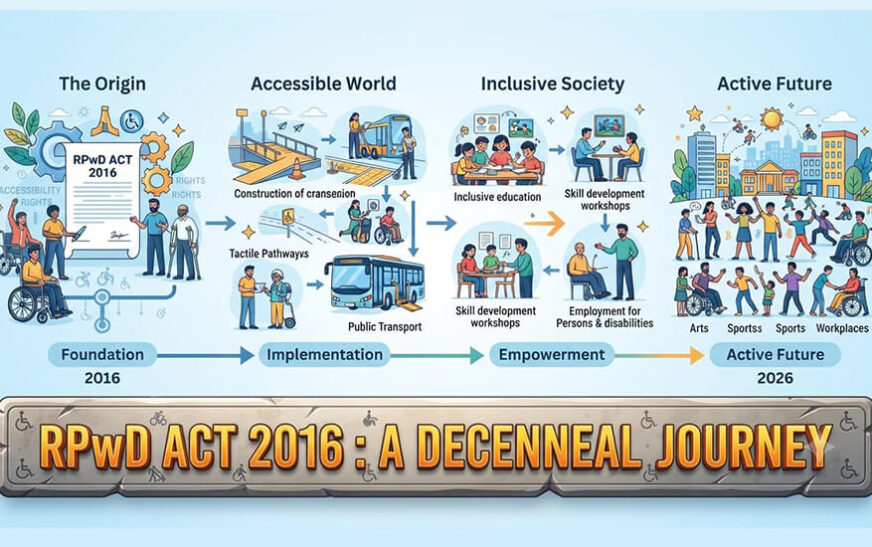
The enactment of the Rights of Persons with Disabilities Act, 2016, replacing the Persons with Disabilities (Equal Opportunities, Protection of Rights and Full Participation) Act, 1995, marked an important transition in India’s disability-rights framework. The legislation expanded the recognised categories of disabilities from seven to twenty-one and incorporated a rights-based approach consistent with the UNCRPD.
Nevertheless, a fundamental contradiction persists: India recognises disability rights in law but frequently fails to recognise them in institutional practice.
A person may possess the legal right to education but encounter an inaccessible university building. A qualified professional may be entitled to equal employment opportunities but face discriminatory assumptions about productivity. A wheelchair user may be legally entitled to access public facilities but discover that the entrance, lift or toilet is unusable.
These are not isolated inconveniences. They represent the continuing denial of substantive equality. The RPwD Act must therefore be examined not merely by the number of rights it recognises, but by the extent to which those rights can be exercised independently, safely and with dignity.
2. The RPwD Act, 2016: Understanding the Legislative Framework and Its Limitations
The RPwD Act is intended to function as a rights-protective legislation rather than a framework of charitable assistance. Its central principles include dignity, autonomy, equality, non-discrimination, accessibility and participation.
Section 3 guarantees equality and non-discrimination and recognises the obligation to provide reasonable accommodation. Section 4 addresses the specific rights of women and children with disabilities. Sections 5–15 deal with community life, protection against abuse, access to justice, legal capacity and related entitlements.
Sections 16 and 17 establish obligations relating to inclusive education. Section 20 prohibits discrimination in employment and requires reasonable accommodation. Section 21 requires establishments to formulate equal opportunity policies. Section 32 provides five per cent reservation in government-funded higher educational institutions for persons with benchmark disabilities, while Section 34 provides not less than four per cent reservation in government establishments.
Sections 40–46 establish the accessibility framework covering the built environment, transportation, information and communication technology and services. The Act also provides institutional mechanisms through the Chief Commissioner, State Commissioners, Special Courts and provisions concerning offences and penalties.
Despite this extensive framework, implementation remains uneven.
The first difficulty is the tendency to equate disability rights with benchmark disability certification. While certification is relevant for certain statutory benefits and reservations, the right to reasonable accommodation cannot be reduced to the possession of a certificate establishing forty per cent disability.
The second difficulty is the institutional treatment of accessibility as an administrative project rather than a legal obligation. Accessibility is frequently postponed on grounds of financial constraints, construction difficulties or institutional priorities.
The third difficulty concerns remedies. Persons with disabilities often have to make repeated representations, approach authorities or initiate litigation to obtain facilities that should have been available as a matter of law.
Consequently, the Act risks creating a framework in which the individual must continuously demand inclusion from institutions that are already legally obligated to provide it.
3. Judicial Interpretation: The Courts and the Expanding Meaning of Disability Rights
Indian courts have played a significant role in transforming disability rights from welfare-oriented entitlements into constitutional guarantees. Three decisions are particularly important.
3.1 Jeeja Ghosh v. Union of India, (2016) 7 SCC 761
The case concerned Jeeja Ghosh, a passenger with cerebral palsy who was removed from an aircraft by the airline despite having a valid ticket and being medically fit to travel. The incident exposed the discriminatory assumptions that often influence institutional decisions concerning persons with disabilities.
The Supreme Court recognised that the treatment violated her dignity and personal autonomy. It emphasised that persons with disabilities cannot be subjected to discriminatory treatment under the pretext of institutional convenience or misplaced concern for their safety.
Critical analysis: The significance of Jeeja Ghosh extends beyond the aviation sector. It demonstrates that discrimination frequently operates through paternalism. Institutions may claim to protect persons with disabilities while simultaneously denying their autonomy and decision-making capacity. Such an approach is inconsistent with the human-rights model of disability. Protection cannot become a justification for exclusion.
3.2 Vikash Kumar v. Union Public Service Commission, (2021) 5 SCC 370
This decision concerned a candidate with writer’s cramp who sought the assistance of a scribe for the Civil Services Examination. The dispute raised an important question concerning the relationship between benchmark disability certification and reasonable accommodation.
The Supreme Court recognised that reasonable accommodation is not restricted to individuals possessing benchmark disability status. It is an essential component of substantive equality and requires institutions to make appropriate modifications so that persons with disabilities can participate equally.
The Court explained that reasonable accommodation is an individualised obligation and that denial of accommodation may itself constitute discrimination.
Critical analysis: This judgment challenges the narrow bureaucratic understanding of disability. A person may experience a functional limitation requiring accommodation without meeting the statutory threshold for benchmark disability. Making access dependent upon a percentage certificate risks excluding individuals whose needs are genuine but do not fit administrative classifications. The decision also establishes that equality is not achieved by treating everyone identically; it requires institutions to respond to different needs.
3.3 Rajive Raturi v. Union of India, 2024 INSC 858
This landmark litigation concerned the accessibility of public spaces, particularly for persons with visual disabilities. The proceedings originated in 2005 and exposed the slow progress in implementing accessibility requirements.
In its judgment dated 8 November 2024, the Supreme Court examined the inconsistency between the accessibility obligations under the RPwD Act and the regulatory framework under Rule 15 of the RPwD Rules, 2017.
The Court held that several guidelines under Rule 15 were merely recommendatory in character despite being presented as mandatory standards. It held Rule 15(1) ultra vires the statutory framework to that extent and directed the Union Government to formulate mandatory, non-negotiable accessibility standards in consultation with relevant stakeholders.
The Court emphasised that establishing a minimum floor of accessibility cannot be left entirely to progressive realisation.
Critical analysis: This judgment exposes one of the most serious weaknesses in India’s disability governance: the gap between statutory obligation and regulatory enforceability. A ramp that is too steep, a lift without accessible controls, a website incompatible with screen readers or a toilet without sufficient manoeuvring space may be described as an accessibility measure while remaining practically unusable.
The judgment establishes that accessibility is not a matter of institutional generosity. It is integral to the constitutional rights to life, dignity and freedom of movement.
Collectively, these judgments establish that disability discrimination includes not only explicit exclusion but also the denial of accommodation, inaccessible environments and institutional practices that undermine autonomy.
4. Discrimination Beyond Legislation: The Everyday Reality of Exclusion
Despite legislative and judicial recognition, discrimination remains embedded in India’s educational, professional, social and administrative institutions.
Infrastructural discrimination: Public universities, hospitals, courts, government offices, railway stations and commercial establishments continue to present accessibility barriers. The absence of accessible toilets, functioning lifts, appropriate ramps, tactile pathways and accessible signage restricts independent participation. Accessibility must be measured by whether an individual can use an entire facility, not merely enter its premises.
Educational discrimination: Admission to an educational institution does not automatically ensure inclusion. Inaccessible classrooms, examination systems, libraries, laboratories and digital learning platforms prevent meaningful participation. Educational institutions must understand that reasonable accommodation is an academic obligation, not an optional concession.
Employment discrimination: Section 34 provides an important reservation framework, but employment equality cannot be achieved through recruitment quotas alone. Discrimination also occurs through inaccessible workplaces, stereotypical assumptions about professional competence, denial of promotion and refusal to provide workplace adjustments. The private sector requires stronger and more explicit accountability.
Digital discrimination: Government portals, online examinations, banking applications, recruitment systems and artificial intelligence tools may exclude persons with visual, hearing, intellectual or physical disabilities. An algorithm that disadvantages an applicant because of disability-related data can reproduce discrimination without an openly discriminatory policy.
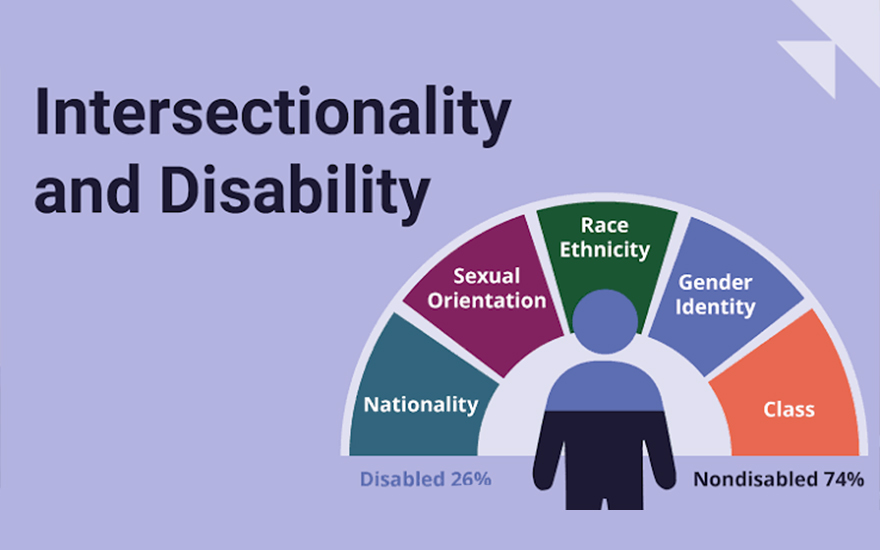
Intersectional discrimination: Women with disabilities, persons with intellectual and psychosocial disabilities, persons from marginalised communities and those living in rural areas face overlapping forms of exclusion. The law must address these intersecting disadvantages rather than assuming that all persons with disabilities experience discrimination in the same manner.
The most concerning aspect is that discrimination does not always arise from deliberate hostility. Institutional indifference, inadequate planning and the failure to consult persons with disabilities can produce equally exclusionary outcomes.
5. Comparative Analysis: India’s RPwD Act and the Americans with Disabilities Act, 1990
The Americans with Disabilities Act, 1990, offers an important comparative framework for understanding disability as a civil-rights issue. The ADA was enacted to prohibit discrimination against persons with disabilities across employment, public services, public accommodations and telecommunications.
Its five titles establish distinct obligations:
• Title I: Employment discrimination.
• Title II: Public services and activities of state and local governments.
• Title III: Public accommodations and commercial facilities.
• Title IV: Telecommunications.
• Title V: Miscellaneous provisions and related protections.
The most significant comparative distinction concerns enforcement and institutional accountability.
Under Title I, covered employers must provide qualified individuals with disabilities equal employment opportunities, including reasonable accommodation unless the employer establishes undue hardship. Title II requires public entities to ensure equal access to programmes and services. Title III imposes accessibility and non-discrimination obligations upon covered private establishments.
An important judicial precedent is Olmstead v. L.C., 527 U.S. 581 (1999). The United States Supreme Court interpreted Title II of the ADA and held that unjustified institutional isolation of persons with disabilities may constitute discrimination. It recognised an obligation to provide community-based services where such placement is appropriate, not opposed by the individual and reasonably accommodated in light of available resources and the needs of others.
The importance of Olmstead lies in its recognition that segregation itself can constitute discrimination. Disability rights are not limited to access to buildings or employment; they also concern independent living, autonomy and participation in community life.
A comparison of the two frameworks demonstrates important differences: