

October of 2026 presents a juncture where Government has recently revamped outreach of National Social Assistance Programme decreasing eligibility of disability percentage to 40% from 80% to receive assistance and increasing centre’s contribution across the age limits which now helps in at least 25% enhancement in output of the scheme.
On the other hand, mandatory provision of UDID since 2023 for disabled people to access range of government schemes remains to witness its full potential with extremely low rate of generation of the cards.
And, so do we hang in between enhancing the outreach and getting counted. As we gear up for much delayed census it’s possible that either of the above stated efforts will seem negligent with rise in numbers of disabled people against last census figures, now that we have larger coverage of disabilities under 2016 act. If and only if, disability sector moves beyond the argument of counting should happen as per type of disabilities or those being categorised under broad categories like done in RPwD Act, 2016 itself, verbatim. Irrespective of either of ways, enumerators cannot practically identify 21 types of disability or going by category assign a wheelchair user in between locomotor and chronic neurological category on their own; unless disabled people or their families ensure right categorisation-based enumeration on their own.
As we speculate further on the same and remain hopeful, it is equally important to look beyond a decade for, realisation of changing patterns of political will in regime of two major political parties and their allies, at national level. The central elections till 2009 witnessed static mention on disability or no mention at all across manifestos of national parties. It is only since 2014, that we witness major shift in pattern of BJP, anything and everything not being left out in generic promises of Indian National Congress while CPI continues to largely copy paste the promises making minor changes each year. The political will at regional elections also remain discorded and illogical with respect to national elections. For example, The BJP’s manifesto for centre focussed on creation of indigenous and affordable assistive technology in 2024, in the preceding years Bihar or Assam did not witness translation of that focus on creation of hubs given, the focus on Bihar shifted on creation of state of art hospital for Autism while for Assam it largely focused on providing livelihood, infrastructural development, a national university for disability study and rehabilitation centre as well as ensuring 100% UDID. While the promise of Indian National Congress highlights dissociative tendencies even more sharply considering that at state level it promises for monthly pension of INR 3000 while for general elections at centre it looks for providing INR 1000 leaving question on how will that additional expense be met? Or, Assam’s manifestos highlight deviation between key promises and priority which can be witnessed in the last Assam’s Assembly election of 2021. Although, there is a detailed Assam Vision Document of 2030 which highlights the state commitment of achieving 16 Sustainable Development Goals, if we compare the key targets of the SDGs with key promises of major political parties contesting elections, the comparative analysis of political parties manifesto indicates a gap between the political will and long term plan under SDGs. And in terms of disability inclusion, only two concerns to fill the vacant seats in the government agencies reserved for disabled people and providing ramps in the government buildings were highlighted in the BJP’s detailed manifesto, and not in key promises. While rest of the parties completely missed inclusion in their agenda. Additionally, if we observe the trends of narratives on the mainstream discourse during election, the focus always lies on the trending topics.
Thus, the very source of energy that leads to the churning of intervention, remains hung between what matters and what materialises.
And, so translates the outcomes of such intent where since 2004 the proportional budgetary allocation towards the subject (when dedicated department did not exist) or say currently towards Department of Empowerment of Persons with Disabilities (DEPwD) has never been a percent of total outcome budget of central government. The Disabled People’s organisation over Census or other critical matters remain either voiceless or with divergent stand. Thus, the focus till date revolves around question of budgetary allocation and not on investment unless of course now, when deliberations of enhancing investment on the subject through CSR has been initiated by the government itself. So, remains the understanding of sector to not focus on utilisation of funds that remain highly unutilised and very well have Disability Inclusion as a priority area of spending unlike the present Schedule VII of CSR; the District Mining Fund. If we look across the annual reports of the same at least in capital of Jharkhand, the state bearing resource needs of this country, then 0% investment has been made till date on the same. Alas! Our sector celebrates State Disability Commissioner more than District collector but the later enjoys better precedence in terms of authority as well as charge to handle resources as such.
We could not materialise the indirect taxes in form of cess to mobilise funds like done for ensuring education. Persons with disabilities will remain an unutilised potential, in absence of investment. The state of affairs towards accessibility remain dismal with merely 1748 government buildings made accessible till 2025. The flagship scheme of Accessible India Campaign is one of the few campaigns where the power to highlight inaccessibility in public spaces was devolved to the users itself through mobile based Sugamya Bharat App, making them active agents of transformation. However, Scheme of Implementation of Persons with Disabilities Act (SIPDA) under which the initiative is managed remains worst utilised accounting heads of DEPwD in last three years where more than two third of allocation remain unspent. The situation in such context turns grave when reasonable accommodation turns into luxury to afford with import charges and lack of indigenously developed assistive technology.
ALIMCO (Artificial Limbs Manufacturing Corporation of India) has been at forefront of indigenous development of assistive technology for decades and it’s sole chunk of sales channel remains with bulk procurement of assistive aids for distribution under ADIP (Assistance to Disabled Persons for Purchase/Fitting of Aids/Appliances) scheme. A great shift in budget of 2026-2027 has been initiated with standalone allocation of 100 crores towards Divyang Sahara Yojana whose vision is to promote indigenous development, enhance sales and post sales service network of assistive technology. It demands for a very valuable transition of ALIMCO for, it will change the operations by diversifying sales channels, marketing strategy and functioning as true business unit enabling for post sales feedback evolving the business unlike mass distribution of assistive aids. Thus, it is for time to decide how well would such transition pan out in timely manner exploring options of contracting out operations, enabling partnerships and collaboration or functioning as traditional PSUs turning into sick industry, as it is since 2022 only that their internal resources have turned sufficient, to not need aid from DEPwD. Thus, the sensitive transition will be fulcrum of changing market dynamics on access to assistive technology as 52% of population remain to have access to it.
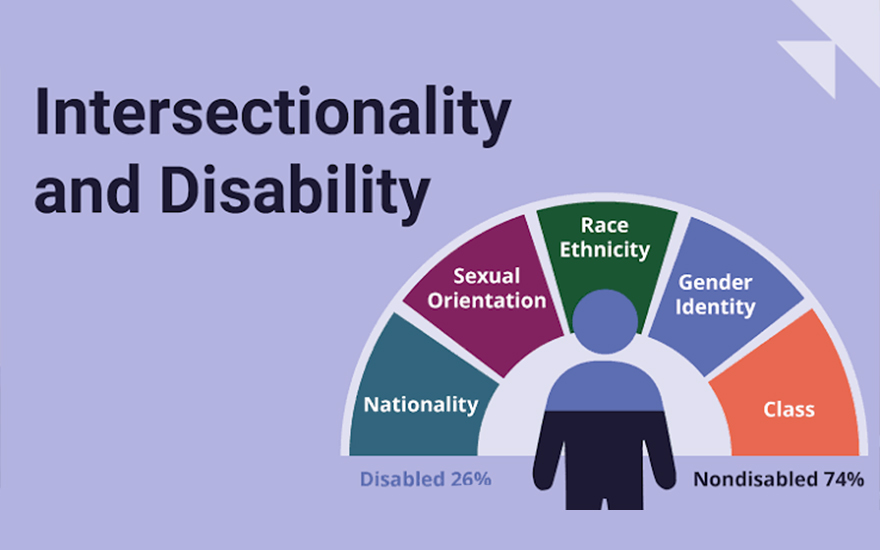
In absence of accessibility and individual’s need of reasonable accommodation, access to education and employment leave room for much to be desired. At rate of 75% dropouts at school level, imagining access to higher education remains a rarity. Even though there is an increase in the enrolment of disabled persons in higher education by 38.1 % by the year 2022-2023, the enrolment of disabled men and female students grew only by 54.4% and 19.0% respectively highlighting the current levels of inclusion and gender gap. The gender gap will widen further in absence of democratisation of technology like smartphones which can reduce the search friction on having access to distance or online education and having larger access to employment opportunities like was stated in budget speech of this year hoping for inclusion of disabled people in AVGC (Animation, Visual Effects, Gaming, and Comics) industry. The report highlights a significant disparity of 19 % can be found between disabled and non-disabled group in India as a percentage of population that owns mobile phones. And if we focus on gender wise distribution, then only 51 % of disabled women has access to mobile phones as compared to 64 % by disabled men, 66% by non- disabled women, and 81% by non-disabled. Crucial difference can be found in terms of internet usage, only 19 % disabled women has internet access and have basic knowledge of it such as video calling, watching videos, and using social media like Facebook and Instagram as compared to 21% by non-disabled women, whereas 36 % disabled men has access to internet as compared to 43% by non-disabled men. Education is not the sole professional engagement where access to technology highlights the gender gap.
The UNDP report of 2024, highlights that “the workforce participation rate for persons with disabilities in India stands at around 36%, compared to approximately 60% for those without disabilities. The disparity is even starker when examining gender: while 47% of men with disabilities are employed, only 23% of women with disabilities have jobs. These figures point to systemic barriers, ranging from attitudinal biases and inaccessible infrastructure to educational inequities and limited inclusive hiring practices”. In terms of their participation in the public sector only 1.76% which is slightly better than the private sector which constitutes only 0.26 % in the year 2025. Despite the RPwD Act, 2016 mandates 4 % reservation of Persons with Disabilities in Public Sector, the workforce participation doesn’t even constitute 50% of mandate at best case scenario as per the report. In terms of Skill training, the Department of Empowerment for Persons with Disabilities in partnership with the Ministry of Skill Development and Entrepreneurship (MSDE) envisioned to train 2.5 million disabled persons by 2022. A few months later the Sector Skill Council for Persons with Disabilities (SCPwD) enhanced this target to 4 million. The live counter of their website till date records training to ~176270 candidates and ~250000 candidates in the overall training irrespective of individual skill sectors by the National Skill Development Council (NSDC) which is far away from either of the targets 4 years after 2022. With regards to the self-employment as well for Disabled Persons, the National Divyangjan Finance and Development Corporation (NDFDC) has not even supported 10,000 beneficiaries over the last two financial years and the progress of their entrepreneurial journey cannot be ascertained to be progressive.
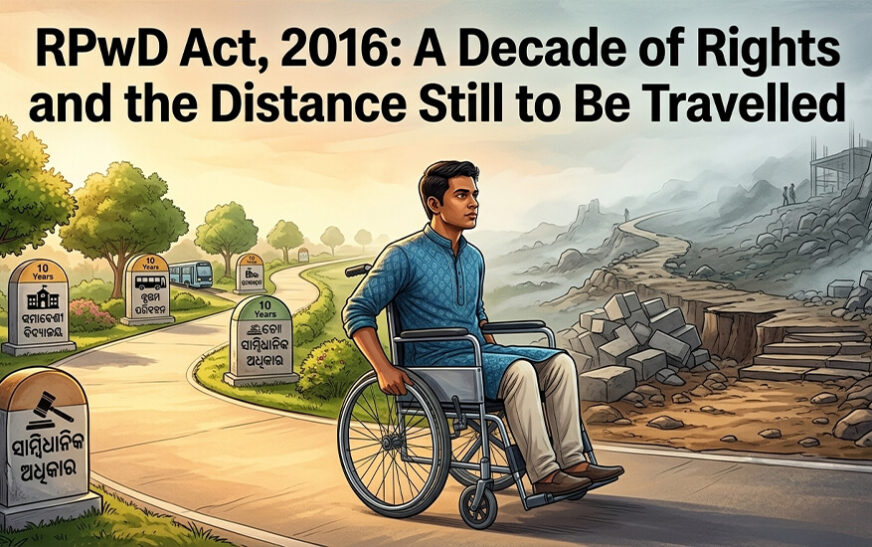
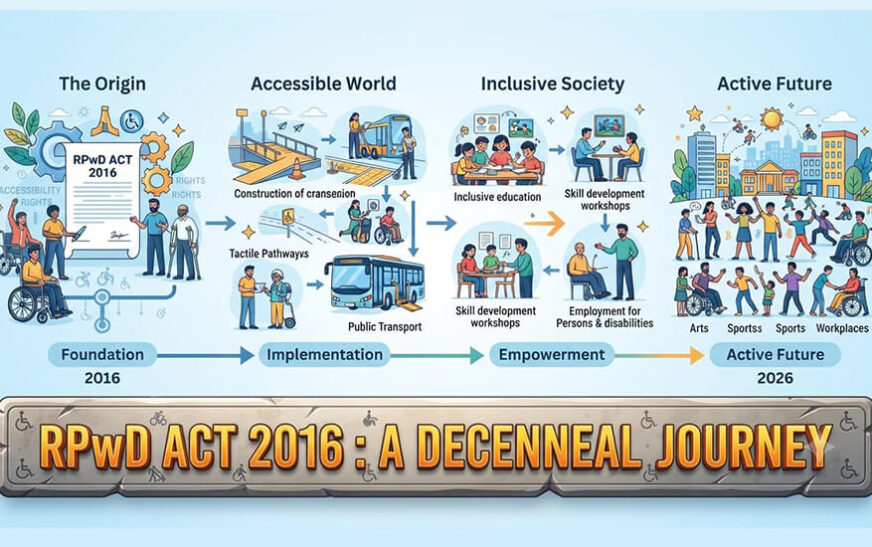
It is thus a hypothesis to be checked in future on whether initiatives like “this” may effectively, efficiently, wilfully lead to all “that” we expect towards creating the basic foundation of society inclusive of all. Till then, we continue being hung between covering the distance from this to that as we look forward to another decade of implementation of Rights to Persons with Disabilities Act 2016.
References:
- Press Information Bureau Delhi. (2026, October 14). Cabinet approves continuation of the National Social Assistance Programme for five years from 2026-27 to 2030-31. Press Information Bureau. https://www.pib.gov.in/www.pib.gov.in/Pressreleaseshare.aspx?PRID=2323264
- UDID Will Be Mandatory for Availing Benefits of Govt Schemes from 01.04.2023 | The Administration of Union Territory of Ladakh | India. https://ladakh.gov.in/udid-will-be-mandatory-for-availing-benefits-of-govt-schemes-from-01-04-2023/. Accessed 9 Nov. 2026.
- UDID. https://swavlambancard.gov.in/Pendencyreport. Accessed 9 Nov. 2026
- Ali, A. (2026, October 21). Why enumeration matters for disability inclusion | Hindustan Times. Hindustan Times. https://www.hindustantimes.com/ht-insight/economy/why-enumeration-matters-for-disability-inclusion-101792583037104.html
- Parikshit, S. (2026, October). समाज, सरकार और विविध कारोबार — जनगणना पर विचार. Medium. https://medium.com/@parikshit.sumeet/समाज-सरकार-और-विविध-कारोबार-जनगणना-पर-विचार-3dda2d196d5b
- Parikshit, S. (2023, October 18). Status of disability inclusion in political manifesto of major political parties in India: Transformation from 2004-2023. Scribd. https://www.scribd.com/document/678354126/Status-of-Disability-Inclusion-in-Political-Manifesto-of-Major-Political-Parties-in-India
- Sankalpa Patra. (2026). BJP Manifesto for 2026 Assam State Assembly Election. Assam_Vidhansabha_Election_Manifesto_2026_30_3_2026_High Res
- Baruah, A, & Parikshit, S. (2026, February). Deviation from the script: Assam election 2021. Academia.Edu. https://www.academia.edu/165231049.
- Parikshit, S & Baruah, A. (2026, February 2). Trends in the Budgetary Allocation for Department of Empowerment of Persons with Disabilities from financial year of 2020 to 2026-2027. Scribd. https://www.scribd.com/document/625245205/Trends-in-Budgetary-Allocation-for-Department-of-Empowerment-of-Persons-with-Disabilities-India
- Sharma, Y. S. (2026, October 19). Disability, elderly care likely to qualify for CSR spending. Economic Times. The Economic Times. https://m.economictimes.com/news/india/disability-elderly-care-likely-to-qualify-for-csr-spending/articleshow/135054779.cms
- District Mineral Foundation Trust (DMFT). DMFT Ranchi | DISTRICT RANCHI, GOVERNMENT OF JHARKHAND | India
- ClearTax. (2023, June 9). Education cess. ClearTax. Cleartax. https://cleartax.in/glossary/education-cess
- Government of India, Ministry of Social Justice and Empowerment, Department of Empowerment of Persons with Disabilities. (2025). Accessible India campaign: Status and monitoring mechanisms (unstarred question no. 4838) (pp. Annexure (State–wise details of accessible government buildings)). https://sansad.in/getFile/loksabhaquestions/annex/184/AU4838_2ZXeOf.pdf?source=pqals
- Press Information Bureau. (2026, February 1). Divyang Kaushal Yojana to provide customized training to divyangjan in it, AVGC and hospitality sectors. Press Information Bureau. https://www.pib.gov.in/www.pib.gov.in/Pressreleaseshare.aspx?PRID=2221393
- Senjam, S. S., Manna, S., Kishore, J., Kumar, A., Kumar, R., Vashist, P., Titiyal, J. S., Jena, P. K., Christian, D. S., Singh, U. S., & Kamath, R. (2023). Assistive technology usage, unmet needs and barriers to access: A sub-population-based study in India. The Lancet Regional Health – Southeast Asia, 15, 100213. https://doi.org/10.1016/j.lansea.2023.100213
- Agarwal, K. (2020, May 17). Why 75% of India’s disabled kids never attend a school in their lifetime. ThePrint. https://theprint.in/opinion/un-report-75-india-disabled-kids-never-attend-school-in-lifetime/423440/
- Press Information Bureau, Government of India. (2026, August 30). A decade of growth, access, and inclusion: Building India’s knowledge ecosystem: A decade of progress. Press Information Bureau (PIB). https://pib.gov.in/FactsheetDetails.aspx?Id=150983
- Government of India Nirmala Sitharaman Minister of Finance. (2021). https://www.indiabudget.gov.in/doc/Budget_Speech.pdf
- Bridging the gap: Enabling disability inclusion in India’s private sector workplaces. (2024). UNDP. https://www.undp.org/india/blog/bridging-gap-enabling-disability-inclusion-indias-private-sector-workplaces
- Sinha, S., Kumar Jain, N., & ETHRWorld. (2025, December 21). Disability inclusion: India Inc’s rhetoric vs reality. ETHRWorld Contributor. ETHRWorld.Com. https://hr.economictimes.indiatimes.com/news/workplace-4-0/diversity-and-inclusion/disability-inclusion-india-incs-rhetoric-vs-reality/126105438
- Government of India, Ministry of Social Justice & Empowerment. (2015, March 21). National action plan for skill training of persons with disabilities launched. Press Information Bureau. https://www.pib.gov.in/newsite/PrintRelease.aspx?relid=117556®=48&lang=2
- Home | the skill council for persons with disability. Scpwd.In. https://scpwd.in/
- National Skill Development Corporation (NSDC). www.nsdcindia.org. https://www.nsdcindia.org/
- Year wise total Disbursement. National Divyang Finance and Development Corporation. Department of Empowerment of Persons with Disabilities.
Anwesha Baruah
Program Officer (Javed Abidi Fellowship on Disability) at the National Centre for Promotion of Employment for Disabled People (NCPEDP) and alumnus of Jamia Millia Islamia.
Sumeet Parikshit
Program Manager at the National Centre for Promotion of Employment for Disabled People (NCPEDP). In this role, he leads the prominent NCPEDP-Javed Abidi Fellowship on Disability, which focuses on fostering leadership, public policy advocacy, and disability inclusion among youth.