For years, I carried one line from a government primary school in Mayurbhanj with me: “Inclusive classrooms are theoretical.” A teacher told me this, not with anger, but with the tired honesty of someone who had tried and failed to make an idea work in a room too small for it.
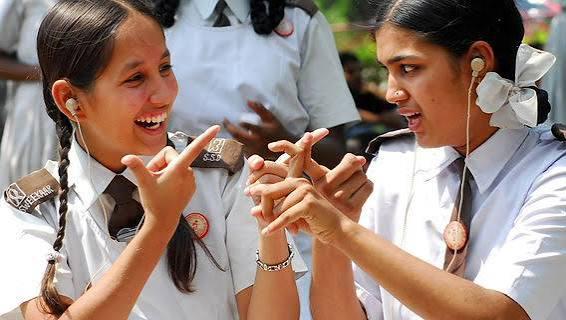
I was directing a deaf inclusion project at SADHANA, supported by Deaf Child Worldwide, UK. We had identified seventeen government schools across the tribal district of Mayurbhanj where at least one deaf child was enrolled in Class One. Our task, on paper, was straightforward: to help teachers include these children in ordinary classroom learning. In practice, it meant confronting what “inclusion” actually asks of an under-resourced rural school.
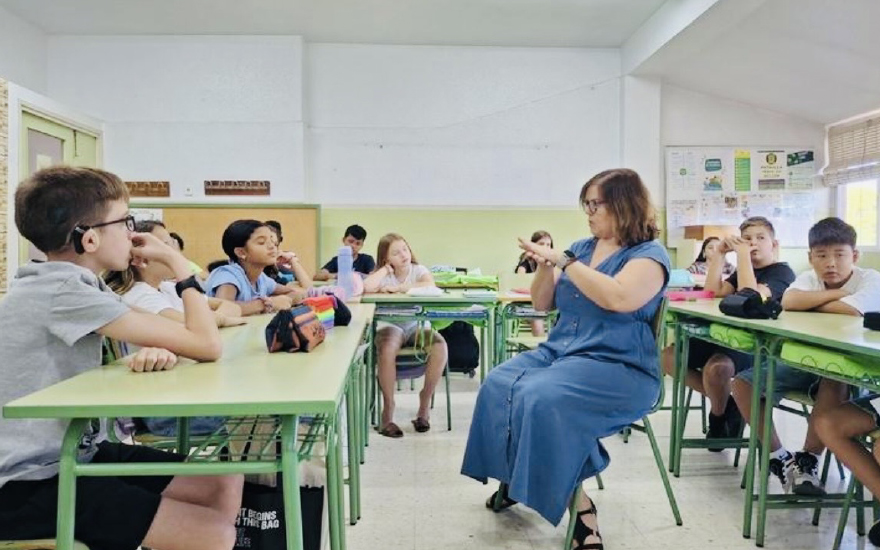
The teacher who called inclusion theoretical was not being difficult. She was managing three grades in one room, four children in Class One, three in Class Two, five in Class Three, and one of her Class One students was deaf. “How can I give time to one child who cannot talk or understand,” She asked, a genuine question. It was a common refrain across the schools we visited. Most teachers assumed that if a deaf child could not hear, they could not understand either, a misconception that shaped how little was expected of these children, and how much frustration teachers carried.
We needed something that did not ask teachers to do more, to teach differently instead.
The opening came from an ordinary lesson. The Class One Odia-medium environmental studies textbook has a chapter called “Muni jaithila haata ku” (Muni went to the Market) built around a single small illustration of a local haat, with instructions for teachers to prompt discussion: What is a market for? Why do people go there? What shops have they seen? For a hearing child, the teacher’s spoken questions carried the lesson. For a deaf child sitting silently at the back, that one small picture was the entire lesson, and it was not enough to build a conversation around.
We took the idea to Jasmi Hembram, a deaf artist we worked with. She redrew the market scene in far greater detail: a vegetable stall, a grocer, a tailor’s shop, a fish seller, a butcher, a blacksmith, a cycle repair shop, a tea stall, a row of parked cycles, trees marking the boundary of the haat. The market was rendered the way someone looking at one would see it: full of separate, specific things to notice and name.

We printed the picture in colour and gave a copy to each deaf child in all seventeen schools when that chapter came up in class.
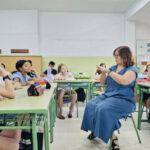
What happened next was consistent enough to notice. Children who usually sat alone became a small point of gravity in the room. Classmates drifted over to look at the picture but not out of instruction, instead with curiosity. They pointed and argued about which shop was which, mimed buying and selling. We asked teachers to encourage this, and to let children use whatever signs or gestures came naturally rather than waiting for formal language structure. Slowly, without anyone guiding the lesson, the class worked out together what a haat was and what happened there.
When we later asked the teachers what they thought, one answer stayed with me: it was good to have a deaf child in the classroom, because the other children learned more, from the picture, and from each other. A sentence that had been offered to us months ago as an excuse for exclusion had turned into an argument for the opposite.
I want to be careful about what this small change proves. It did not fix multi-grade teaching, or teacher training, or the deeper structural gap between what an inclusive classroom is supposed to look like and what an under-resourced school can offer. One adapted picture in one chapter is not a system.
But it did show something worth extrapolated on: children do not need to be taught to include a disabled classmate. Left with the right material and a little room, they worked it out themselves — through curiosity, negotiation, and the ordinary business of figuring out a market scene together. What they were practicing was not charity toward a deaf classmate. It was something closer to the everyday skill of living alongside people who are different from you — noticing, adjusting, working things out together.
A classroom with a deaf child in it is not a harder classroom to teach. It is a different one, with different resources to draw on; only if someone takes the initiative to make those resources available. Disability, in that room, was not the problem to be managed around. It was one more form of difference that a classroom exists to help children learn about and live with.
The teacher who once told me inclusion was theoretical never told me she was wrong. She did not have to. The children in her classroom had already answered her.
Ranjit Mahapatra
Email- ranjit.mahapatra@gmail.com
Programme Manager, Handicap International (Humanity and Inclusion, Odisha
Ex-Director, Society for Action in Disability and Health Awareness (SADHANA),
Bhubaneswar