
What is Developmental Disability?
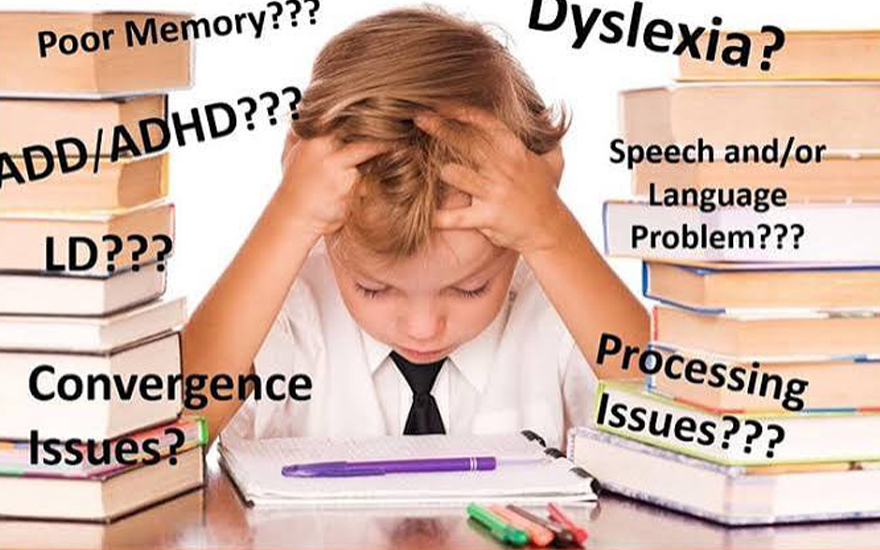
Developmental disability is the disability observed in children during the developmental period, that is, from birth to 18 years of age. It includes a diverse group of chronic conditions that are due to mental or physical impairments. Developmental disability causes many difficulties in certain areas of life, especially in language, mobility, learning, self-help, and independent living. It can be detected early in life, and do persist throughout an individual’s lifespan. It affects all areas of a child’s development and sometimes referred to as global developmental delay. Major types of developmental disabilities include Learning Disability, Intellectual Disability, Autism Spectrum Disorders, Cerebral Palsy, and Attention Deficit Hyperactive Disorders (ADHD).
Characteristics of Problem Behaviour:
Many times, children with Developmental Disabilities show behaviours that are considered as problematic because of the harm or inconvenience caused to others or to the child. The presence of problem behaviour in children gives strain to teachers, parents and others concerned. Besides, they may interfere with activities in the home and classroom settings. These problem behaviours could be due to a number of reasons like, deficits in adaptive behaviour skills, cognitive skills and/ or problem-solving skills. However, children with normal intelligence also show problem behaviours. In fact, to some extent, exhibition of problem behaviour is a normal developmental phenomenon. Generally, with the advancement of age, children with normal intelligence learn to behave appropriately in the given situations. This may not be achieved by the children with low intelligence.
Hence, it is necessary to draw some guidelines to call a specific behaviour as problem behaviour:
a) Behaviour which is harmful to oneself.
b) Behaviour which is harmful to others.
c) Behaviour which interferes with the learning tasks.
d) Behaviour which is not socially acceptable.
e) Behaviour which is not age-appropriate.
Techniques of Problem Behaviour Management
A) Punishment Techniques
Punishment is a behavioral technique, used for controlling / reducing / preventing the occurrence of undesirable behavior. Punishment is presentation or withdrawal of an event followed by behavior to decrease the occurrence of that behavior. The following are the punishment techniques used to control the undesirable behavior of children with developmental disabilities.
i) Restructuring of the environment (Environmental manipulation):
If it is established that both antecedents and the consequence have the immediate environmental influences for undesirable behavior, restructuring the environment could control the occurrence of that undesirable behavior. For example, if it is established that ‘Rupesh’ always makes the shriek noise during the class due to the antecedent factor that, whenever ‘Jayant’ sits next to ‘Rupesh’, he always tickles Rupesh; and due to the consequence, that, everybody laugh when ‘Rupesh’ make the noise, that gives him a pleasant feeling. Here, the restructuring of the environment can be done by changing the seating position of ‘Rupesh’ and ‘Jayant’.
ii) Extinction:
Extinction is the technique of re-arranging the consequence of an undesirable behaviour so that attention or activity rewards do not follow. It is also called as ignoring. This includes non-presentation of a reward that is not giving attention to the child. Ignoring involves not coaxing, not chasing behind the child, not scolding, not giving an activity, not looking at him, or not noticing the child. Ignoring is the easiest technique to describe, yet one of the most difficult techniques to implement effectively.
For example, a) some of the problem behaviors cannot be ignored, like, if the child is harming others or self to get attention, immediate intervention is essential.
b) The problem behavior initially shows an increase before it comes down while using extinction method.
c) If extinction is used, then all others concerned with the child have to apply this technique. Otherwise, if attention is not given by one person the child may obtain it from others, thereby continuing problem behavior.
iii) Time out:
Time out is the process of weakening of undesirable behavior pattern by removing the individual to a non-reinforcing area. It is essential to establish that there was reinforcement for the occurrence of the problem behavior. During time out, a child is put in a situation where any possibility for reward is removed entirely for a short period of time (2 to 3 minutes). For example, to stand in the corner of the room facing the wall, immediately following the problem behavior, or keep the head down on the desk etc.
iv) Response Prevention:
Response prevention is prevention of the undesirable behaviour even before its occurrence. For example, to hold the hand of the child before he beats others, thereby preventing it to occur. Response prevention may elicit an immediate and forceful repetition of the undesirable behaviour. However, the intention here is not to indulge in a physical conflict with the child. Hence response prevention should be implemented after carefully analyzing the behaviour which is to be modified.
v) Physical Restraint:
Physical restraint is restricting the physical activities after the occurrence of an undesirable behaviour. Mild physical restraint is helpful to bring down aggressive behaviours. This includes restriction of the physical activity of the child, for example, tying hands of the child immediately at his / her back for a short period of time (2 to 3 minutes) – not tight enough to the extent of giving pain, or holding the hands gently to sides and saying assertively not to repeat the behaviours like biting self, thumb sucking, tearing papers etc, when it occurs.
vi) Response Cost:
Response cost is a technique in which an already awarded reinforcement (as part of strengthening the occurrence of a desirable behaviour) is taken back, following an undesirable behaviour. This method is generally used when tokens are being given in response to successful performance for increasing the desirable behaviours so that, following particular problem behaviour, the tokens earned by the child is taken back. Here, the person pays the cost of doing a particular ‘undesirable behaviour’.
vii) Restitution / Restoration:
This refers to a procedure that requires an individual to return the environment to its state prior to the occurrence of a problem behaviour that has changed the environment. That is, restoring the disturbed environment back to the normal condition. For example, a child throwing rubbish, paper, books, cloth, different house hold articles on the floor, is to pick up the same and put in the waste paper basket or appropriate places.
viii) Over Correction:
This is a technique which involves a combination of procedures. It not only teaches what the person should not do but also educates what person should do. It is of two types:
a) Restitutional Overcorrection: – It refers to restoring the disturbed environment back to more than normal conditions. The person following occurrence of problem behaviour, for example, throwing food on the floor, is asked to clean not only that area but the entire room.
b) Positive practice: – It refers to practicing an appropriate behaviour as a consequence for inappropriate behaviour. It means stopping all activities, whenever an error occurs and then carefully performing the correct behaviour several times.
No reinforcement is awarded after the positive practice or restitution is implemented. It may happen that at times, the child may refuse to obey the instructions involved in positive practice or restitution. In that case, he has to be physically guided to do so (not by applying force). Even after this if the child refuses, his preferred activities (Example, playing, watching TV, wearing a particular dress etc.) or materials, or even most preferred food items like fruits, sweet etc. (not the essential food) can be withheld.
ix) Aversive Therapy:
It is a technique that reduces the frequency of the undesirable behaviour by associating it with real or imagined aversive stimuli during a conditioning procedure. The procedure involves application of mild shock (between 10 to 60 volts) to induce a painful stimulus or the presentation of a strong and disgusting smell followed by an undesirable behaviour. This method is used very rarely and when all other techniques fail to give results. For example, in conditions like severe head banging or other similar type of self injurious behaviour it is suggested that this technique be implemented and monitored by a trained clinical psychologist.
B) Non- Punishment Techniques
Non-punishment techniques are the first choice of management plan for reducing the undesirable behaviour. Non-punishment techniques simultaneously aim at the reduction of the undesirable behaviour and the occurrence of a desirable behaviour. The principle used in achieving this is the differential reinforcement techniques. Differential reinforcement is the procedure of the application of reinforcement to one of the two alternatives. There are four types of differential reinforcement:
i) Differential Reinforcement of Incompatible Behaviour (DRI):
This is also called as Differential Reinforcement of Opposite behaviour. The technique involves the reinforcement of the exactly opposite behaviour to the undesirable behaviour. For example, if a hyperactive child sits at a place for a specific period / duration, it is reinforced.
ii) Differential Reinforcement of Other Behaviour (DRO):
It is the process of reinforcing a desirable behaviour when by chance a child does not show an undesirable behaviour. For example, a child who beats others for minor reasons, if he does not do that on a particular day or for a specific period of time, and is engaged in some other activity which is not problematic, is reinforced.
iii) Differential Reinforcement of Alterative Behaviour (DRA):
It is the process involving the diversion of a probable undesirable behaviour by presenting a desirable behaviour and reinforcing it. For example, two children who fight frequently for trivial reasons are given an opportunity to work together to make something both of them like very much, and are frequently reinforced for their joint effort. In reality, the frequent fighting behaviour is replaced by a desirable behaviour of joint completion of a task.
iv) Differential Reinforcement of Low rate of Response (DRL):
This technique is used to control a behaviour which is desirable in low frequency, but is not desirable when occurs more frequently. The technique involves reinforcing the behaviour in its low frequency level and ignoring it in its high frequency level. For example, a child is repeatedly asking the teacher whether next day is a holiday, despite being told every time that it is not a holiday. Here, asking this question once is reasonable and a desirable behaviour. But asking the same question repeatedly despite being told every time is an undesirable behaviour. DRL can be applied here by responding to his question only once and not paying attention to his question when it is repeated. This, over a period of time will make the child to maintain the desirable behaviour in its required frequency.
C) Self-Management Techniques
Apart from the Punishment and Non-Punishment techniques, there is another technique which is known as “Self-Management Technique”. In case of children of mild intellectual disability and other developmental disabilities, particularly at the upper age levels, teachers can use these techniques, through which skill training programme or problem behaviours can be managed in an effective manner.
Self–management generally refers to actions designed to change or maintain one’s own behavior. Self-management intervention in the class room involves teaching a child to engage in behaviours like self-monitoring, self-instruction etc. in an effort to change the target behaviours. Examples of target behaviours are: completing a given task in the school, paying attention to classroom activities or managing one’s own problem behavior. All self-management interventions assume that a child’s problem behavior reflects a skill deficit. Self-management approaches include contingency based and cognitive based approaches.
Contingency based approach focuses on consequences of appropriate and inappropriate behaviour. Examples of this approach are self-monitoring, self-evaluation, and self-reinforcement.
Cognitive based approach focuses on antecedents of appropriate behaviour. Examples of this approach are self-instruction, stress inoculation, and social problem solving.
1. Contingency based approach:
i) Self-monitoring – In this approach, children are instructed to observe specific aspects of their own behaviour and provide an objective recording of these observations.
ii) Self-evaluation – It involves the comparison of one’s own behaviour against a self-determined or externally determined standard. For example, a teacher may ask students to rate their classroom behaviour at the end of each period using a five-point scale.
iii) Self-reinforcement – It involves three conditions, that is, free access to reinforcers, self-imposed standard of performance that must be attained prior to reinforcement, and self-determination that the performance criterion has been satisfied prior to reinforcement.
2. Cognitive based approach
i) Self-instruction – It involves teaching children specific verbalizations to direct their own behaviour. For example, children with impulsive and hyperactive behaviour were taught to use overt, and eventually covert, speech to guide their overt actions.
ii) Stress inoculation training – It involves cognitive regulation and skill training for the management of anger and anxiety. The term ‘inoculation’ describes the central procedure of exposing the child to manageable stressor, thereby allowing him to gradually learn to cope.
iii) Social problem-solving training – The overall goal in this approach is to develop ‘thinking’ skills that will enhance the child’s social problem-solving behaviour. Social problem-solving approaches tend to be highly structured and include components, such as, problem identification, problem definition, generation of alternative solutions, and implementation of the most appropriate solution.
A well-known example of the social problem-solving approach is the ‘think a loud’ programme, which involves teaching elementary-aged students to ask four basic questions when confronted with potentially difficult situations: what is my problem? What is my plan? Am I using my plan? And how do I do?
Conclusion
Various types of problem behaviors are shown by the persons with developmental disabilities. It is important for parents, neighbors, and school teachers to observe the problem behaviours, make detailed notes of the types and frequency of problem behaviours and understand its dynamics. The above-described techniques for the management of problem behaviours can be used in consultation with a Special Educator or Psychologist.
Dr. Narayan Chandra Pati
Professor of Psychology, Utkal University (Retd.)
General Secretary, Chetana Institute for the Mentally Handicapped, Bhubaneswar